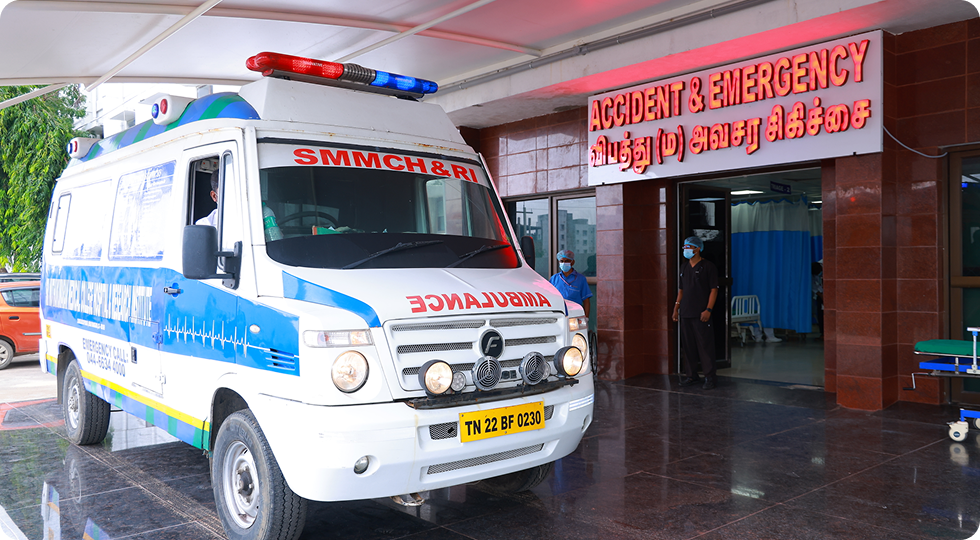
Ambulance services
The hospital operates 24×7 ambulance services for emergency response, inter-facility transfers, and critical care transport, ensuring rapid access to trained paramedics and seamless coordination with Emergency and Trauma Care and ICU teams. Units are equipped for basic and advanced life support with continuous vital monitoring, airway equipment, oxygen delivery, and emergency drugs under established transport protocols.
Onboard ventilation support
- Noninvasive ventilation: BiPAP and CPAP are available in ambulances for acute respiratory failure, COPD/asthma exacerbations, cardiogenic pulmonary edema, and post-extubation support when appropriate, with adjustable pressures, integrated humidification, and continuous SpO2/ECG/NIBP monitoring.
- Oxygen therapy: High-flow oxygen delivery with flow meters and multiple masks/circuits; backup oxygen cylinders and safety-checked manifolds are maintained.
- Airway readiness: Bag–valve–mask with oxygen reservoir, oropharyngeal/nasopharyngeal airways, suction, and difficult-airway adjuncts for safe escalation if NIV fails.
Staffing and oversight
- Each ambulance runs under the capable oversight of emergency physicians and anesthesiologists, with trained EMTs/paramedics skilled in NIV initiation, titration, mask fitting, and transport monitoring.
- Protocol-driven care includes inclusion/exclusion criteria for NIV during transport, escalation triggers, infection-control steps, and handover checklists for receiving teams.
Key equipment summary
Monitoring
Multi-parameter monitor (ECG, SpO2, NIBP), capnography where indicated.
Resuscitation
Defibrillator with pacing, BLS/ACLS kits, IV/IO access, fluids, and essential emergency medications.
Immobilization and trauma
Spine board, cervical collars, splints, pelvic binder, and burn kits.
Communication and readiness
Two-way communication with Emergency Department, GPS-enabled dispatch, and documented pre-departure equipment checks.
Quality and safety
- Regular maintenance, calibration, and sterility/infection-control protocols for NIV circuits and masks are enforced.
- Crew training includes periodic simulations on NIV in transport, airway rescue, and transport safety, with continuous audit of response times and outcomes.